GMAT Score Calculator & Converter: Focus Edition
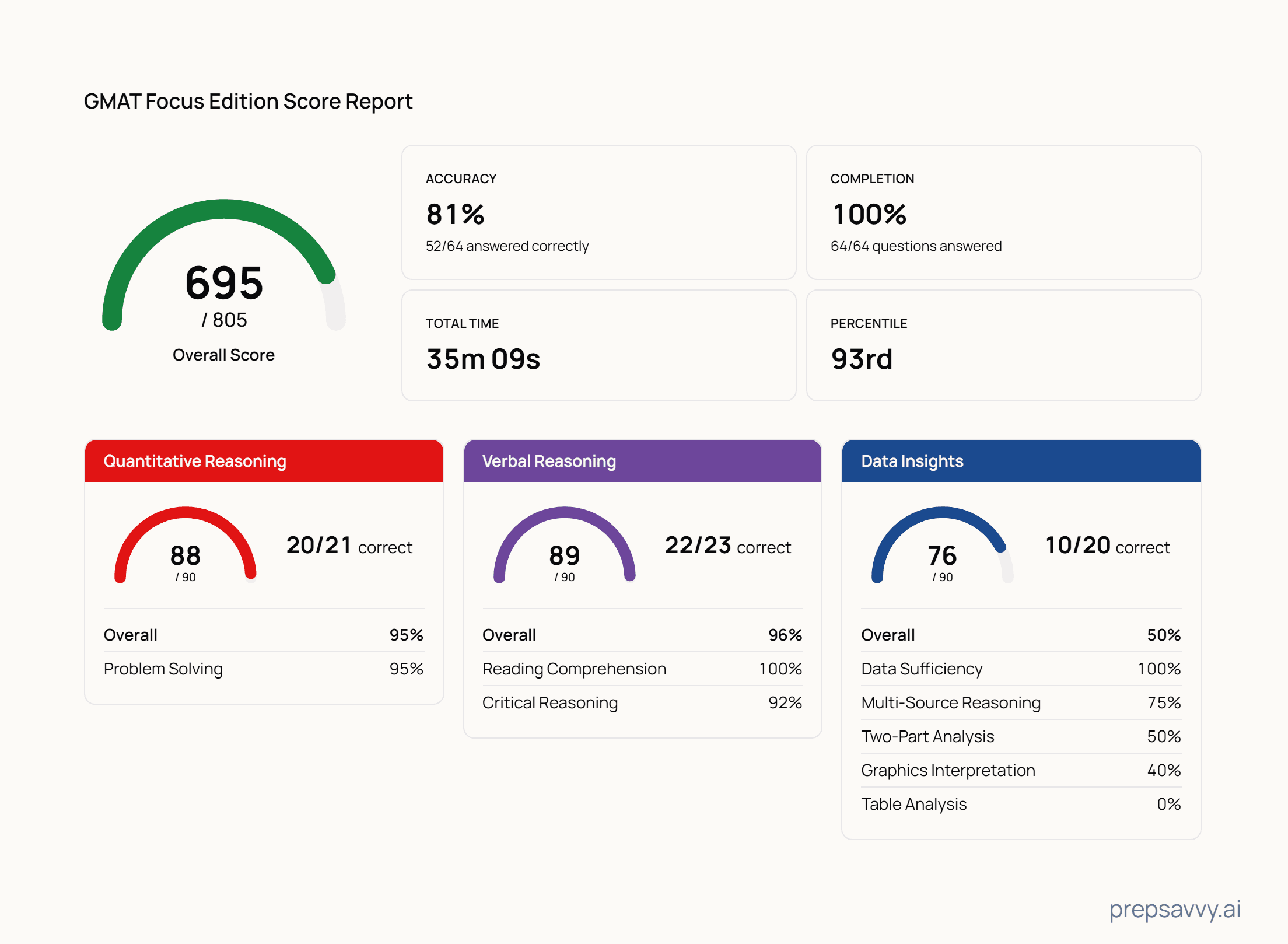
Estimate your GMAT Focus Edition score (205 to 805) from the number of questions you answer correctly per section, and convert any score between the old GMAT scale (200 to 800) and the Focus Edition scale using the official GMAC concordance table.

By Mark Khoury, Founder
Updated October 8, 2026
Calculate or convert your score
Scale 200 to 800, published in steps of 10. Entries between steps round to the nearest point.
Focus Edition score
Enter a score to see the conversion.
This converter uses the official GMAC concordance table. PrepSavvy practice exam scores are PrepSavvy's own estimates, not scores issued or endorsed by GMAC.
How the calculator estimates your score
The Score Calculator tab estimates your GMAT Focus Edition total from the number of questions you answer correctly in each section. The Focus Edition has 21 Quantitative questions, 23 Verbal questions, and 20 Data Insights questions. Each section is scored from 60 to 90, and the three section scores combine into a total on the 205 to 805 scale. Enter your raw correct count per section and the calculator maps each count onto a 60 to 90 section score, then combines the three into a total. The percentile under the total comes from GMAC's 2021 to 2026 percentile data, the same table the converter uses. The estimate assumes every question carries medium difficulty. The real GMAT is computer-adaptive, so the questions you see get harder or easier based on your performance. Two test takers with the same raw count can land on different scaled scores because one saw harder questions. Treat the calculator's output as a rough orientation, not a prediction. A full-length PrepSavvy practice exam uses the adaptive model and produces a tighter estimate. The study plan under the results ranks your sections from weakest to strongest and links to a topic-by-topic guide for each, so you can start drilling the section that will move your total the most.
What the concordance is
GMAC launched the GMAT Focus Edition in late 2023 on a new 205 to 805 scale and published an official concordance table so scores from the two editions can be read against each other. The concordance maps each old score to the Focus score that holds the same standing among test takers. The scales are not linear copies of each other. The old scale compressed its top end, so classic gaps near 800 widen on the Focus scale: an old 790 converts to a Focus 775, while an old 800 converts to a Focus 805. Near the bottom the effect reverses, and the old 200, 210 and 220 all convert to a Focus 205. Both scales move in steps of 10, and the converter rounds every entry to the nearest published concordance point before it converts.
What the concordance cannot tell you
GMAC describes the concordance as a guide for orientation, not an exact equivalence. An old score corresponds to a band of Focus scores rather than one number, and both scales carry measurement error, so neighboring scores are closer than their 10-point gaps suggest. When you compare across editions, compare percentiles rather than raw numbers; admissions teams read the percentile and convert internally. The concordance also covers total scores only. GMAC publishes no conversion for section scores, because Data Insights has no equivalent on the old exam and the old Quant and Verbal scales, 0 to 60, do not map onto the Focus section scales of 60 to 90. Each program sets its own policy on how an old score weighs against a current one.
PrepSavvy scores and official scores
PrepSavvy practice exams report scores on the Focus 205 to 805 scale. Those scores are PrepSavvy's own estimates, calibrated against the published GMAC percentile tables. GMAC does not issue them and does not review or endorse them. The converter on this page uses the official GMAC concordance for every edition-to-edition conversion, the calculator uses PrepSavvy's scoring model to estimate a Focus score from raw correct counts, and the percentile shown with each result comes from GMAC's 2021 to 2026 percentile data.
Keep reading
GMAT scores and percentiles
The official percentile tables for the total score and every section, and what a good score is.
GMAT Quantitative
Practice questions, strategies, and topic guides for every Quant concept on the Focus Edition.
GMAT Verbal
Practice questions, strategies, and topic guides for Reading Comprehension and Critical Reasoning.
GMAT Data Insights
Practice questions, strategies, and topic guides for every Data Insights question type.
GMAT hub
Every GMAT guide: format, fees, dates, study plans and comparisons, plus free practice by topic.
Preparing for the GMAT?
Practice with unlimited adaptive GMAT-style questions, exact feedback, and full-length exams at peak difficulty.