GMAT Integrated Reasoning: The Complete Reference
Integrated Reasoning was retired from the GMAT Focus Edition in 2024 and replaced by Data Insights. This reference covers every IR question type, how each maps to its Data Insights equivalent, and how the scoring changed.

By Mark Khoury, Founder
Updated October 8, 2026
Integrated Reasoning was retired from the GMAT
Integrated Reasoning was removed from the GMAT when the Focus Edition launched on February 1, 2024. The classic GMAT was replaced by the current exam, which folds all four IR question types into the new Data Insights section and adds Data Sufficiency (previously on Quant). The IR standalone score (1 to 8) no longer exists.
This page is a reference for students using legacy prep materials or older practice tests that still include Integrated Reasoning. For current GMAT preparation, visit the Data Insights hub.
What Integrated Reasoning tested
Integrated Reasoning was introduced to the GMAT in June 2012 as a standalone section designed to measure the ability to analyze and synthesize information from multiple sources presented in realistic formats. The IR section presented data in tables, graphs, and multi-tab layouts and asked test-takers to interpret, sort, and draw conclusions from it.
The classic GMAT IR section had 12 questions in 30 minutes. Unlike the Verbal and Quant sections, IR was scored separately on a scale of 1 to 8 in single-point increments, and the IR score did not contribute to the 200 to 800 total score.
IR questions were interactive. Some required sorting table columns, others required using an on-screen calculator (available only during IR, not Quant), and many combined multiple sub-questions into a single item. Partial credit was not awarded: every part of a multi-part question had to be answered correctly for the question to count as correct.
The IR section tested skills that the traditional Verbal and Quant sections did not cover in isolation: integrating data from graphics and text, evaluating trade-offs across multiple variables, and interpreting information presented in non-narrative formats like sortable tables and multi-tab displays.
The four IR question types
Integrated Reasoning had four question types, each testing a distinct data-analysis skill.
Table Analysis presented a sortable spreadsheet of data and asked true/false or yes/no questions about the information. You could sort the table by any column to find patterns, compare rows, and verify statements. The skill tested was the ability to extract and evaluate quantitative relationships from structured data.
Graphics Interpretation presented a graph, chart, or scatter plot and asked you to fill in blanks in a statement by selecting from drop-down options. The skill tested was reading and interpreting visual data, including trends, proportions, and relationships between variables.
Two-Part Analysis presented a short scenario and asked two related questions, each with its own set of answer choices. The two questions were connected: they tested complementary aspects of the same problem. The skill tested was solving a problem from two angles simultaneously.
Multi-Source Reasoning presented information across two or three tabs (a mix of text, tables, and graphics) and asked multiple questions that required synthesizing information across tabs. You could switch between tabs but could not view them simultaneously. The skill tested was integrating information from multiple sources to evaluate claims and answer questions.
How each IR question type maps to Data Insights
| Classic IR question type | Current Data Insights equivalent | What changed |
|---|---|---|
| Table Analysis | Table Analysis | Same format and skills. Now contributes to the Data Insights score (60 to 90) instead of the standalone IR score (1 to 8). |
| Graphics Interpretation | Graphics Interpretation | Same format and skills. Now scored as part of Data Insights. |
| Two-Part Analysis | Two-Part Analysis | Same format and skills. Now scored as part of Data Insights. |
| Multi-Source Reasoning | Multi-Source Reasoning | Same format and skills. Now scored as part of Data Insights. |
| Not on classic IR | Data Sufficiency | New to Data Insights. Previously on the Quant section. Tests whether you have enough information to answer a question, not the answer itself. |
How the scoring changed
On the classic GMAT, Integrated Reasoning was scored on its own scale of 1 to 8 in single-point increments. This score was reported separately and did not contribute to the 200 to 800 total score. Business schools could see the IR score, but most weighted the total score and section scores more heavily.
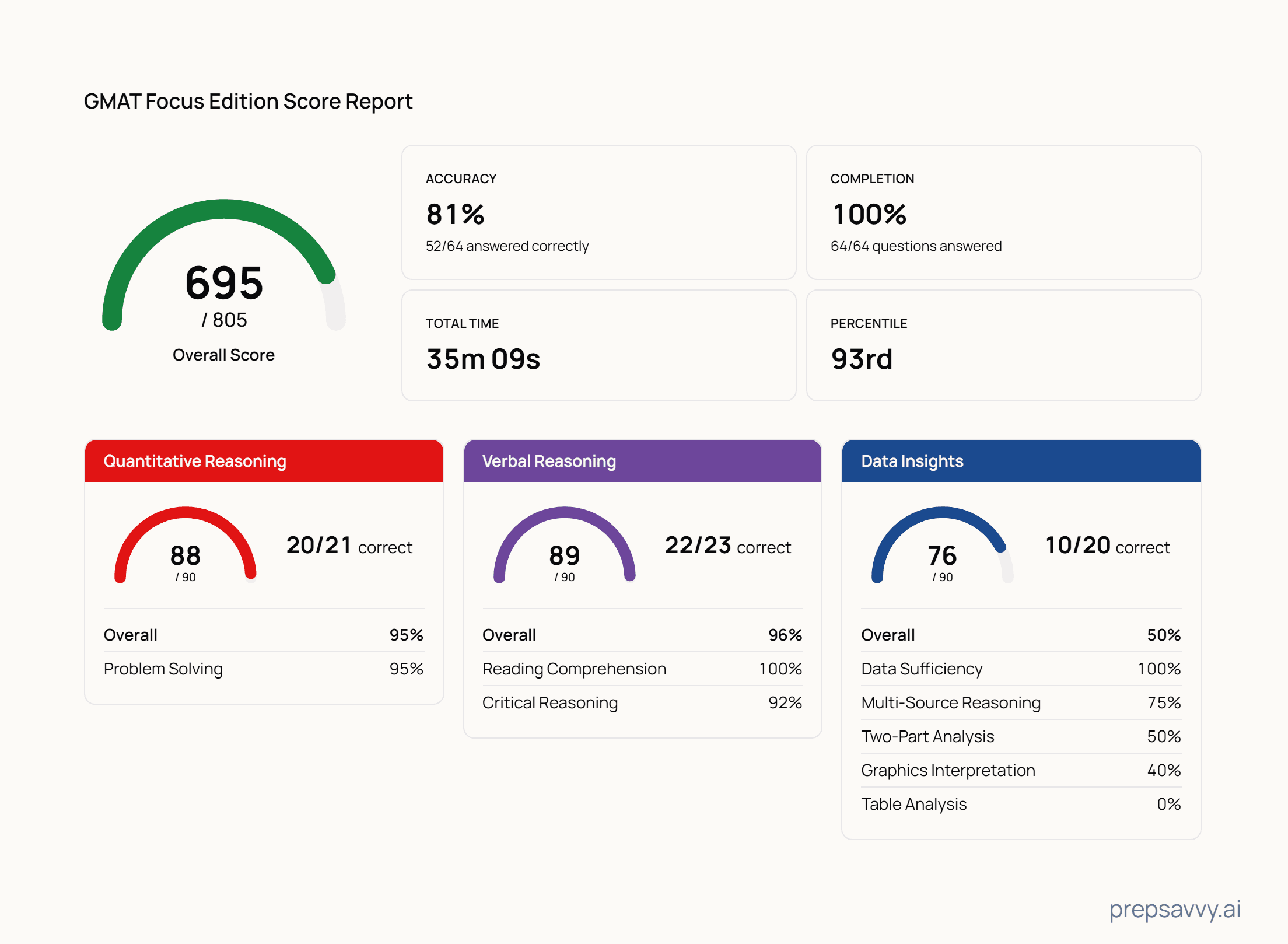
On the current GMAT (Focus Edition), Integrated Reasoning no longer exists as a standalone section. The four IR question types are now part of the Data Insights section, which is scored on a scale of 60 to 90 and contributes to the total score (205 to 805). Data Insights is one of three scored sections alongside Quantitative Reasoning and Verbal Reasoning.
The key change is that the skills IR tested now count toward the total score. A strong Data Insights performance raises the total score the same way a strong Quant or Verbal performance does. The standalone 1 to 8 IR score is gone.
The Data Insights section has 20 questions in 45 minutes on the current GMAT, compared to the classic IR section of 12 questions in 30 minutes. The current section is longer because it includes Data Sufficiency alongside the four former IR types.
Preparing with current Data Insights materials
If you are preparing for the current GMAT, you do not need legacy IR materials. The four IR question types are still on the exam, now inside Data Insights, and the practice questions on the Data Insights hub cover them in the current format.
The practice pages below each cover one Data Insights question type with full worked explanations. Every question is in the current GMAT Focus Edition format.
- Table Analysis practice
- Graphics Interpretation practice
- Two-Part Analysis practice
- Multi-Source Reasoning practice
- Data Sufficiency practice
If you are using older prep books or practice tests that label these questions as Integrated Reasoning, the skills transfer directly. The question formats did not change. Only the scoring and the section name changed.
What carried over and what did not
The four IR question types carried over to Data Insights with identical formats. The on-screen calculator, however, is available throughout the entire Data Insights section on the current GMAT, not just during IR. On the classic exam, the calculator was restricted to the IR section.
What did not carry over:
- The standalone 1 to 8 IR score. The current exam does not report an IR score at all.
- The separate IR section timing. Data Insights runs as one 45-minute section covering all five question types.
- The 12-question IR count. Data Insights has 20 questions total across all types.
What did carry over:
- The four question type formats (Table Analysis, Graphics Interpretation, Two-Part Analysis, Multi-Source Reasoning).
- The interactive elements: sortable tables, drop-down selections, multi-tab displays.
- The data-analysis skills each type tests. The questions are the same in structure and difficulty.
Integrated Reasoning questions
Is Integrated Reasoning still on the GMAT?
No. Integrated Reasoning was removed when the GMAT Focus Edition launched on February 1, 2024. The four IR question types (Table Analysis, Graphics Interpretation, Two-Part Analysis, Multi-Source Reasoning) now live inside the Data Insights section, along with Data Sufficiency.
Can I still use old IR practice materials for the current GMAT?
Yes. The four IR question type formats are identical in Data Insights. Old IR practice questions for Table Analysis, Graphics Interpretation, Two-Part Analysis, and Multi-Source Reasoning are still valid preparation. The only difference is that these questions now count toward the Data Insights score (60 to 90) and the total score (205 to 805), not a standalone 1 to 8 IR score.
What was the classic IR score scale?
Integrated Reasoning was scored from 1 to 8 in single-point increments. The IR score was reported separately and did not contribute to the 200 to 800 total score. On the current GMAT, the IR score no longer exists. Data Insights is scored from 60 to 90 and contributes to the 205 to 805 total.
How many IR questions were on the classic GMAT?
The classic IR section had 12 questions in 30 minutes. The current Data Insights section has 20 questions in 45 minutes, covering all four former IR types plus Data Sufficiency.
What is the difference between IR and Data Insights?
Integrated Reasoning was a standalone section on the classic GMAT with its own 1 to 8 score. Data Insights is a scored section on the current GMAT (60 to 90) that includes the four former IR question types plus Data Sufficiency (moved from Quant). Data Insights contributes to the total score. IR did not.
Should I study Integrated Reasoning if I am taking the current GMAT?
Study Data Insights, not IR. The question types are the same, but the current materials reflect the current scoring, timing, and format. Use the Data Insights practice pages on this site for current-format questions with full explanations.
- 1GMAC, mba.com, GMAT exam structure (Data Insights section) (checked October 2, 2026)
- 2GMAC, mba.com, GMAT FAQs (Focus Edition replacement, February 1, 2024) (checked October 2, 2026)
- 3GMAC, About the GMAT Focus Edition (what changed, IR to Data Insights) (checked October 2, 2026)
Keep reading
GMAT Data Insights practice
Free practice questions for every Data Insights question type on the current GMAT.
GMAT format
What changed when the Focus Edition replaced the classic exam, including the IR to Data Insights transition.
Table Analysis practice
Free Table Analysis practice questions with full explanations on the current Data Insights format.
Graphics Interpretation practice
Free Graphics Interpretation practice questions with full explanations on the current Data Insights format.
Two-Part Analysis practice
Free Two-Part Analysis practice questions with full explanations on the current Data Insights format.
Multi-Source Reasoning practice
Free Multi-Source Reasoning practice questions with full explanations on the current Data Insights format.
Preparing for the GMAT?
Practice with unlimited adaptive GMAT-style questions, exact feedback, and full-length exams at peak difficulty.