GMAT Study Plan: A 12-Week Arc From Diagnostic to Test Day
A week-by-week GMAT study plan anchored to GMAC's own numbers: six weeks minimum, 60-plus hours for most test takers, 90-plus for top scorers, and what to do in each phase.

By Mark Khoury, Founder
Updated October 3, 2026
How long you need
GMAC's guidance is a six-week minimum at a consistent pace, with the majority of test takers preparing for 60 hours or more, and top scorers, those at or above the 89th percentile, reporting over 90 hours. At 8 hours a week, 90 hours is twelve weeks, which is the arc this page is built on. Compress it to 8 weeks by raising weekly hours; do not compress it by skipping the exam simulations.
Work backward from your target programs' deadlines, not from a feeling of readiness. Book the exam first, leave one retake window inside your application timeline, and remember scores are valid for five years: an early test with a superscore attempt later is a legitimate strategy.
The 12-week arc
- 1
Week 1, baseline. Take a full-length diagnostic under real timing. You need three numbers: your total, your section spread, and your pacing per question.
- 2
Weeks 2 to 5, Quantitative Reasoning. Arithmetic and algebra only, through topic sets and error review. No calculator, ever, in practice.
- 3
Weeks 6 to 8, Verbal Reasoning. Reading Comprehension passages on science, social science and business, and Critical Reasoning by question family: strengthen, weaken, assumption, evaluate, resolve.
- 4
Weeks 9 to 10, Data Insights. All five formats, with the on-screen calculator, practicing multi-part questions where every part must be right.
- 5
Week 11, mixed and adaptive. Random-section sets at exam pacing, and at least one adaptive full-length so the difficulty changes feel normal.
- 6
Week 12, dress rehearsal. Two full-lengths at your real appointment time of day, review of the error log, and logistics: passport, route to the center, or the online whiteboard rehearsal.
The weekly rhythm
Three focused topic sessions of 60 to 90 minutes, one section each.
One mixed 20-question set at exam pacing, about two minutes per question.
One review session over nothing but your error log: why each miss happened, which trap it was.
From week 6 on, one timed full section per week; from week 9 on, one full-length exam per week.
What to study, by section
Quantitative Reasoning is 21 Problem Solving questions on arithmetic and elementary algebra, with no calculator and no geometry. Drill topics, not question counts: number properties, ratios and percents, algebraic manipulation, and word problems that combine them. Verbal Reasoning is 23 questions of Reading Comprehension and Critical Reasoning only; there is no Sentence Correction to study. Data Insights covers five formats, Data Sufficiency, Multi-Source Reasoning, Table Analysis, Graphics Interpretation and Two-Part Analysis, with an on-screen calculator and all-parts-correct scoring. The syllabus page has the complete topic lists.
Official and PrepSavvy materials
The official core is the GMAT Official Guide 2026-2027 with 975-plus real GMAT questions, and the free official Starter Kit, which includes Practice Exams 1 and 2 at no cost, with paid official exams 3 through 6 available beyond that.
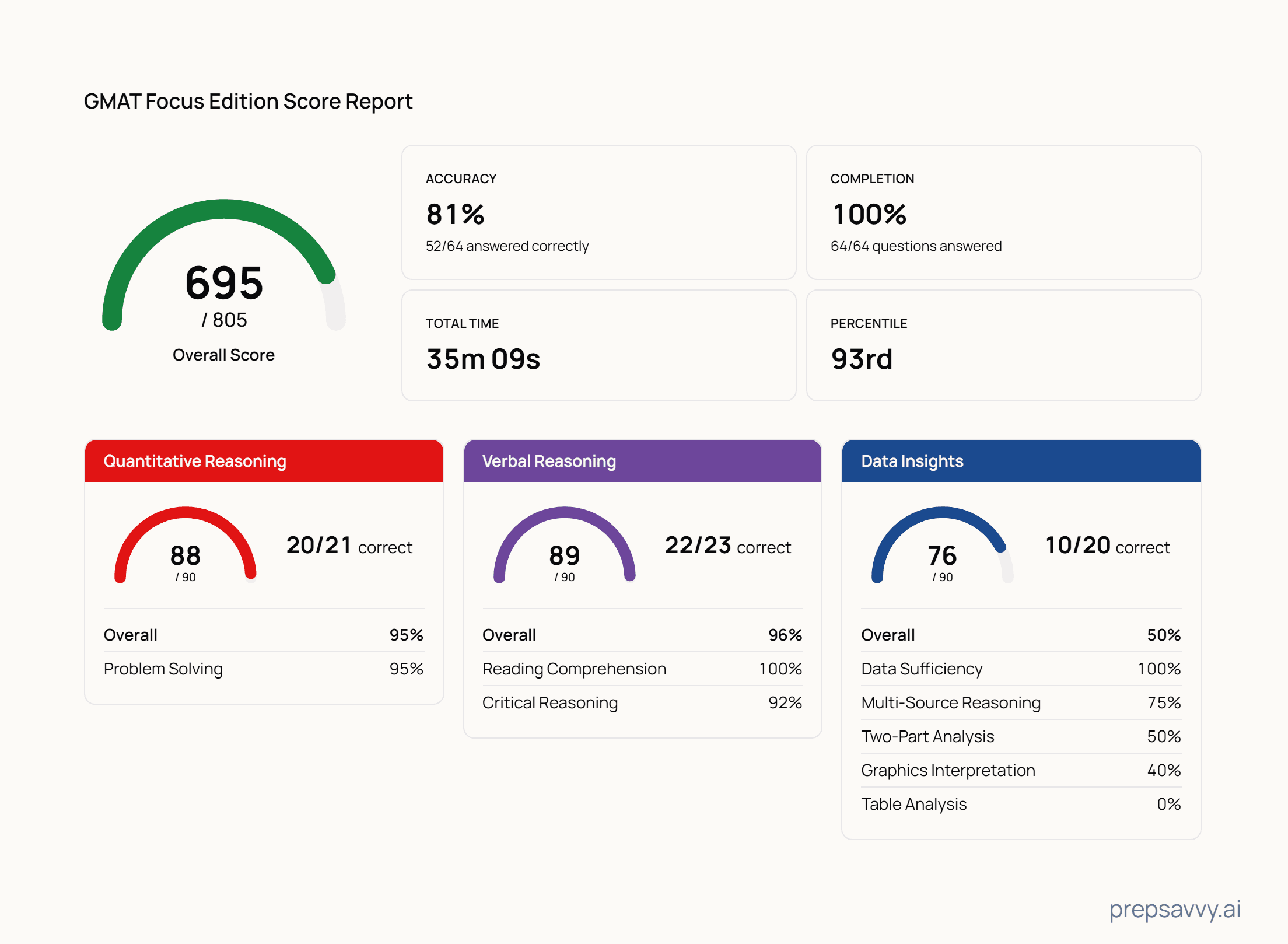
PrepSavvy covers the practice volume: 2,500-plus GMAT questions with an explanation for every answer, 40 full-length exams, an adaptive mode that re-estimates your ability after every answer and serves the next question at the difficulty that estimate calls for, and score reports on the official 60-to-90 and 205-to-805 scales. Free topic sets with worked explanations are linked from the GMAT hub.
Study current material only
The Focus Edition replaced the classic GMAT on February 1, 2024. Sentence Correction, the AWA essay and standalone Integrated Reasoning are retired, geometry is out of Quant, and Data Sufficiency now lives in Data Insights. Any book or course drilling those is teaching you content you will not be tested on.
Study plan questions
How long should I study for the GMAT?
Six weeks at a consistent pace is GMAC's stated minimum, the majority of test takers put in 60-plus hours, and top scorers at or above the 89th percentile report over 90 hours. At 8 hours a week that is about twelve weeks.
When should I take my first practice exam?
Week 1. You need a baseline total, a section spread and a per-question pace before any topic studying makes sense, and the diagnostic tells you which of the three sections needs the most weeks.
Can I retake the GMAT if my score is short?
Yes: five attempts in any rolling 12 months with at least 16 days between them, and since August 2026 your best section scores across attempts combine into an automatic Superscore. Leave one retake window inside your application timeline when you book.
Should I study for all three sections at once?
No. Section phases build faster than parallel exposure: Quant first for most test takers, then Verbal, then Data Insights, with mixed and adaptive practice in the final weeks when the section skills need to interleave under the clock.
- 1GMAC, mba.com, GMAT FAQs (six weeks, 60+ hours, score validity) (checked October 2, 2026)
- 2GMAC, How long to study for the GMAT (90+ hours at the 89th percentile) (checked October 2, 2026)
- 3GMAC help center, GMAT official prep products (Official Guide 2026-2027, free Practice Exams 1 and 2) (checked October 2, 2026)
- 4GMAC, mba.com, GMAT exam structure (sections and timing) (checked October 2, 2026)
Keep reading
Preparing for the GMAT?
Practice with unlimited adaptive GMAT-style questions, exact feedback, and full-length exams at peak difficulty.