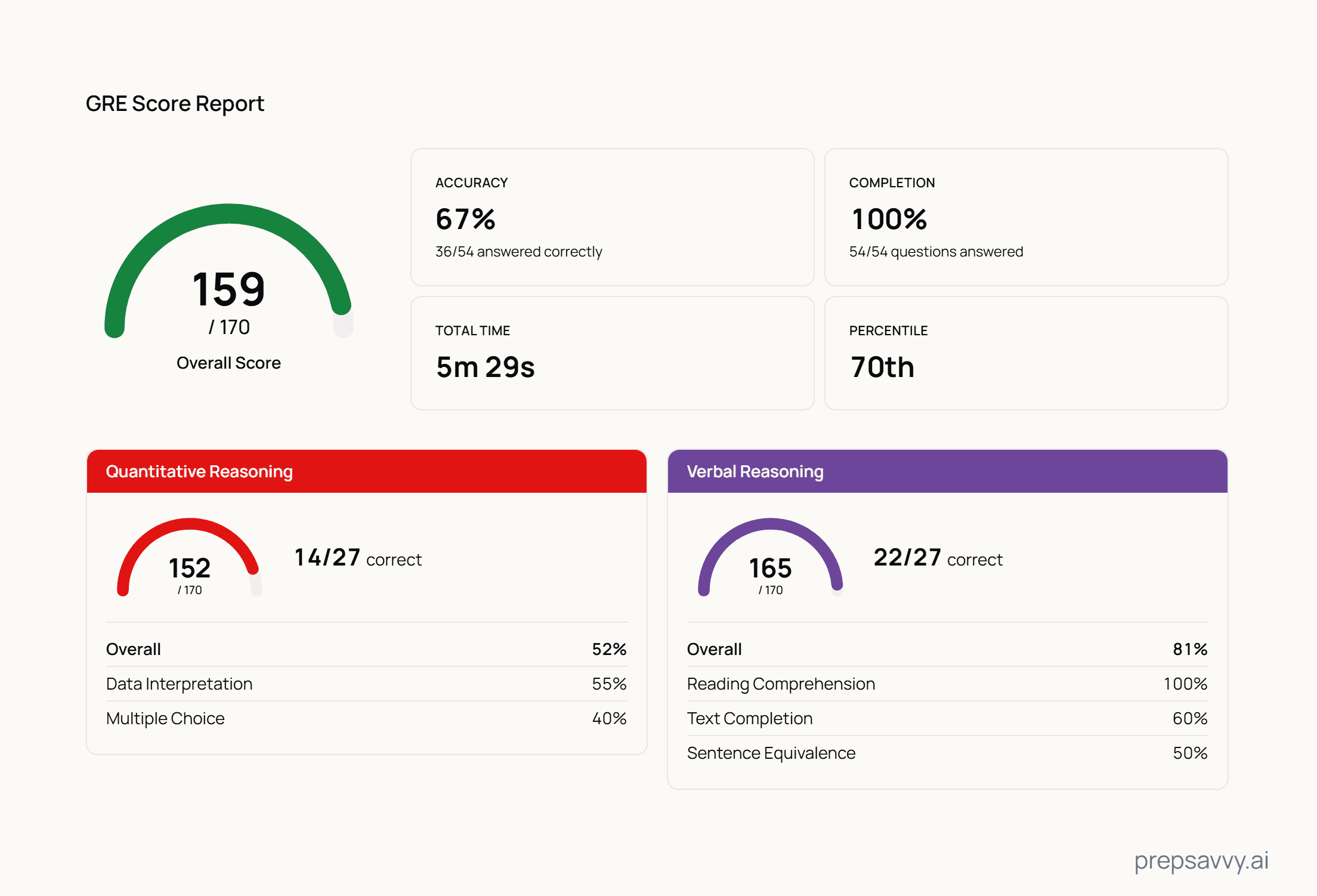
GRE Score Calculator: Estimate Your Score
Enter the number of questions you answered correctly on Verbal and Quant to estimate your scaled scores (130 to 170), your combined total (260 to 340), and your percentiles. The estimator models the GRE section-level adaptive scoring.
Published by PrepSavvy
Updated October 13, 2026
Estimate your score
Questions you answered correctly across both Verbal sections.
Questions you answered correctly across both Quant sections.
Enter the number of questions you answered correctly in each section to estimate your GRE score.
This calculator models the GRE section-level adaptive scoring to estimate scaled scores from your raw correct counts. PrepSavvy practice exam scores are PrepSavvy estimates, not scores issued or endorsed by ETS.
How the estimator works
The GRE scores Verbal Reasoning and Quantitative Reasoning on a 130 to 170 scale in 1-point increments. Each measure has two scored sections: 12 questions in section 1 and 15 questions in section 2, for 27 total. The test is section-level adaptive, which means the difficulty of your second section depends on how well you did on the first. This calculator asks for your total correct across both sections of each measure. It splits your correct count proportionally across the two sections, assigns a medium difficulty to section 1, and routes section 2 to a harder, medium, or easier difficulty based on your estimated section 1 accuracy. It then feeds those synthetic questions through the same difficulty-weighted scoring model PrepSavvy uses for its practice exams, which maps a weighted accuracy onto the 130 to 170 scale. The percentile under each scaled score comes from ETS interpretive data. The Verbal mean is 151 and the Quant mean is 158. A 160 on either measure clears the 70th percentile.
What it cannot tell you
The estimator produces a reasonable approximation, not a guarantee. Three factors limit its precision. First, you enter a single total correct per measure, so the estimator assumes your accuracy is evenly distributed across the two sections. If you answered every section 1 question correctly but missed most of section 2, your real score would differ from the estimate because the adaptive routing and difficulty weighting would not match the model's assumptions. Second, the estimator assigns one difficulty level to all 15 questions in section 2. The real GRE mixes difficulties within each section, and the equating process ETS uses accounts for the specific mix of question types and difficulties you saw. The simplified model approximates the effect but cannot reproduce it exactly. Third, the estimator does not account for the unscored research section or the Analytical Writing measure. It covers Verbal and Quant only, which are the two measures that contribute to the 260 to 340 combined total.
PrepSavvy and official scores
PrepSavvy practice exams report scores on the same 130 to 170 scale using the same difficulty-weighted scoring model this calculator uses. Those scores are PrepSavvy's own estimates, calibrated against the published ETS percentile tables. ETS does not issue them and does not review or endorse them. The percentiles shown with each result come from ETS interpretive data for recent GRE test takers. When you compare your estimate to a target program's median or average, compare percentiles rather than raw scaled scores, because the relationship between scaled scores and percentiles differs between Verbal and Quant. A 170 on Quant is the 96th percentile, while a 170 on Verbal is the 99th.
Keep reading
GRE scores and percentiles
The official ETS percentile tables for Verbal and Quant, the Analytical Writing scale, and what a good score is.
GRE hub
Every GRE guide: format, fees, dates, study plans and comparisons, plus free practice by topic.
GRE Quant practice
Free practice questions for every GRE Quantitative topic, from arithmetic to data analysis.
GRE Verbal practice
Free practice questions for text completion, sentence equivalence and reading comprehension.
Preparing for the GRE?
Practice with unlimited adaptive GRE-style questions, exact feedback, and full-length exams at peak difficulty.