

Top Philosophy Schools Worldwide for Research and Influence
Compare worldwide philosophy research influence, citation concentration and publication growth.


Philosophy majors have spent years answering the same question: “What are you going to do with that degree?”
Aspiring degree holders now have a compelling answer from the companies building artificial intelligence. Anthropic advertises a four-month Conceptual Reasoning Fellowship paying $100,000–$167,000, equivalent to $300,000–$500,000 annualized. The fixed-term program recruits philosophy PhDs, doctoral candidates and researchers with equivalent experience to help evaluate and improve Claude's reasoning. One proposed assignment asks a philosopher to design difficult problems in ethics or formal epistemology.¹
Similarly, Handshake's AI program also advertises Philosophy Expert work for PhDs and postdoctoral researchers at up to $120 an hour. Expertise once treated as detached from the workplace is being recruited to shape how increasingly capable systems reason.²
The connection extends beyond hiring. What counts as knowledge when a model produces a plausible but false answer? Who is responsible when an automated decision harms someone? How should a system resolve a conflict between a user's request and another person's rights? These are philosophical questions inside products used by millions of people. Ethics, epistemology, logic and decision theory supply tools for examining them.
For students considering philosophy, choosing a program therefore involves more than the university's reputation. It means identifying departments producing influential work, research communities gaining momentum, and faculty connecting philosophical inquiry with consequential problems in science and technology.
The research rankings
To identify those research communities, PrepSavvy compared 23,457 articles published in 31 philosophy journals between 2015 and 2024. Across universities worldwide, 112 institutions published at least 50 articles and qualified for the ranking. Our influence score measures their contributions to papers in the most-cited 10% of each journal and publication year. We also measured total citations and publication growth, sharing citation and influence credit between the institutions behind a paper.³
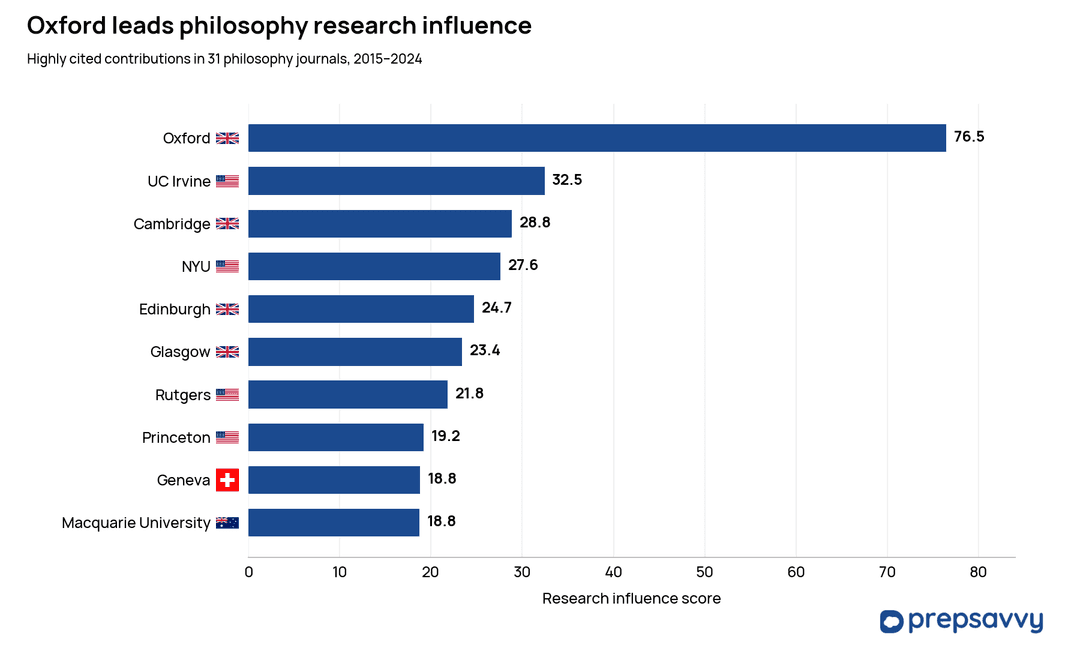
Oxford finishes a clear first, with more than twice the influence score of its nearest competitor. UC Irvine leads the United States, ahead of NYU, Rutgers and Princeton. The top twenty span seven countries.
Research growth compares articles published in 2015–2019 with 2020–2024. It measures publication activity across the same journals throughout both periods.
| Rank | University | Influence | Citations | Articles | Research growth |
|---|---|---|---|---|---|
| 1 | Oxford 🇬🇧 | 76.5 | 13,586 | 576 | +22% |
| 2 | UC Irvine 🇺🇸 | 32.5 | 3,160 | 176 | +93% |
| 3 | Cambridge 🇬🇧 | 28.8 | 4,803 | 280 | +15% |
| 4 | NYU 🇺🇸 | 27.6 | 4,836 | 190 | -17% |
| 5 | Edinburgh 🇬🇧 | 24.7 | 4,371 | 217 | -33% |
| 6 | Glasgow 🇬🇧 | 23.4 | 2,685 | 149 | +53% |
| 7 | Rutgers 🇺🇸 | 21.8 | 4,033 | 186 | -21% |
| 8 | Princeton 🇺🇸 | 19.2 | 2,258 | 155 | +110% |
| 9 | Geneva 🇨🇭 | 18.8 | 1,810 | 128 | +10% |
| 10 | Macquarie 🇦🇺 | 18.8 | 2,080 | 90 | +43% |
| 11 | Groningen 🇳🇱 | 18.1 | 2,436 | 142 | +58% |
| 12 | Australian National University 🇦🇺 | 17.6 | 2,655 | 184 | +7% |
| 13 | Ruhr University Bochum 🇩🇪 | 17.4 | 1,644 | 125 | +112% |
| 14 | King’s College London 🇬🇧 | 17.4 | 2,386 | 162 | +28% |
| 15 | Southampton 🇬🇧 | 17.0 | 2,594 | 103 | -22% |
| 16 | MIT 🇺🇸 | 17.0 | 3,633 | 121 | -17% |
| 17 | Amsterdam 🇳🇱 | 16.3 | 2,253 | 132 | +3% |
| 18 | Helsinki 🇫🇮 | 16.3 | 1,801 | 113 | +35% |
| 19 | St Andrews 🇬🇧 | 16.1 | 2,367 | 145 | -7% |
| 20 | USC 🇺🇸 | 14.6 | 2,305 | 152 | +8% |
Weighing influence
A busy department can publish many papers without producing a comparable share of the work that other researchers build on. The influence score rewards the latter: contributions to the most-cited papers, evaluated against articles published in the same journal and year. That comparison gives a recent paper a more appropriate benchmark than a much older one.
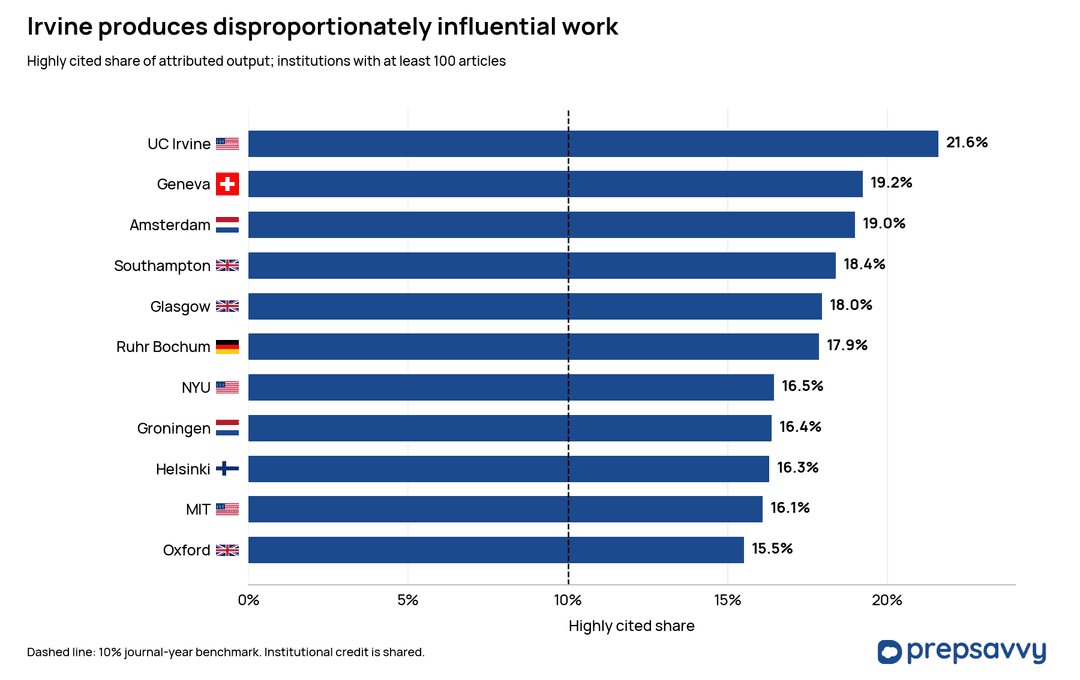
Oxford combines scale with influence. Its 576 articles attracted 13,586 institutionally attributed citations, while its influence score of 76.5 is 2.36 times Irvine's. Its highly cited share, 15.5%, also exceeds the 10% journal-year benchmark. Oxford's lead therefore combines a large research footprint with an above-benchmark concentration of influential work.
For students interested in AI, Oxford also offers a concrete institutional bridge between philosophy and technology. Its Institute for Ethics in AI appointed an inaugural team of seven philosophers in 2020, bringing work on privacy, democratic decision-making and technological responsibility into the Philosophy Faculty. Those appointments document investment in the field alongside Oxford's broader research strength.⁴
Schools with disproportionate influence
UC Irvine ranks second overall despite publishing fewer than a third as many articles as Oxford. Its 21.6% highly cited share is the highest among institutions with at least 100 articles, compared with Oxford's 15.5%. Geneva and Amsterdam follow at 19.2% and 19.0%. For applicants, these results make a useful distinction: a university can have a smaller publication footprint while housing a research community whose work receives unusually concentrated attention.
Irvine's strengths include both its Philosophy Department and its Department of Logic and Philosophy of Science. The latter illustrates why philosophical research matters beyond academic debate. James Owen Weatherall and Cailin O'Connor investigate how false beliefs spread through communities, including environments rich in evidence. Their work connects philosophy of science with mathematical models of social learning and trust, questions with clear relevance to an information environment increasingly mediated by AI. Their book The Misinformation Age develops that research for a wider audience.⁵
Where influential research is growing fastest
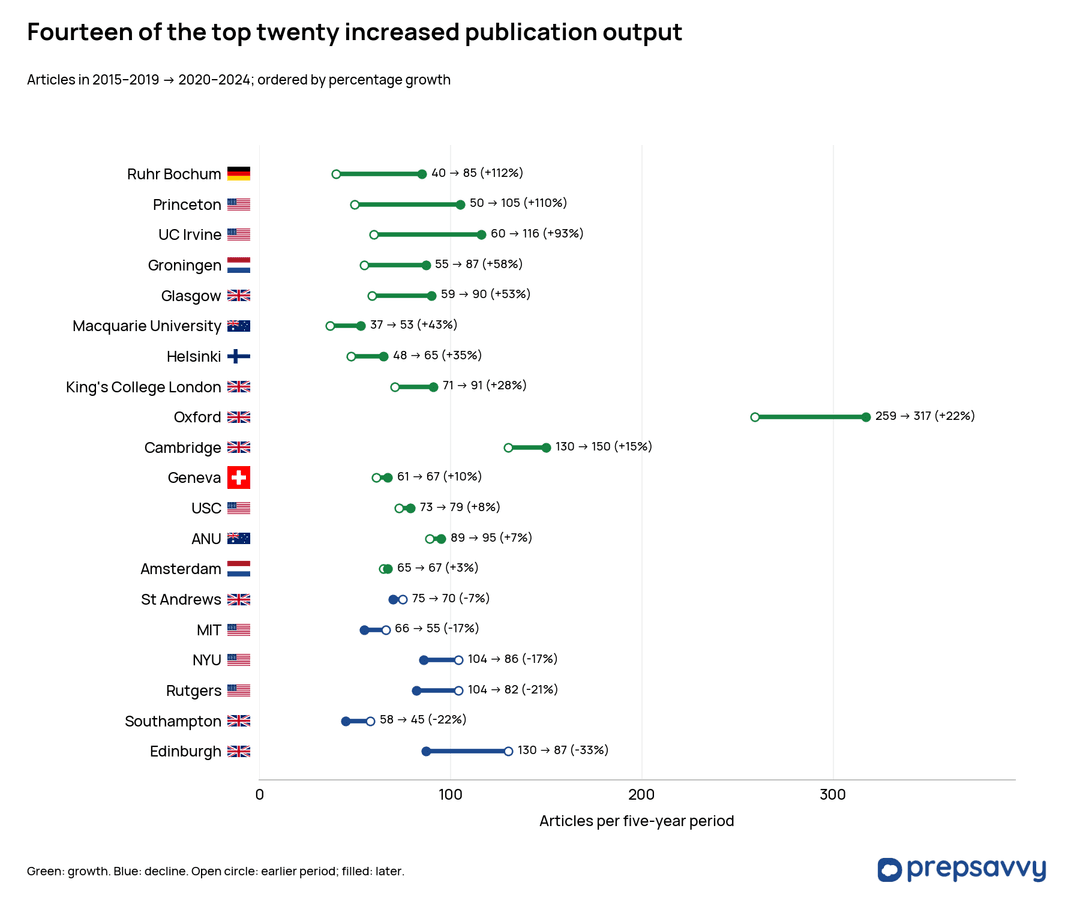
Fourteen of the top twenty increased their output. Princeton more than doubled its articles, from 50 to 105; Ruhr University Bochum rose from 40 to 85; and UC Irvine grew from 60 to 116. These universities combine a top-twenty influence position with rapid expansion in publication activity. Groningen's output increased from 55 to 87, and Glasgow's from 59 to 90.
Oxford also expanded, from 259 to 317 articles. Its larger starting point makes a 22% increase substantial in absolute terms: 58 additional articles, slightly more than Irvine's increase of 56. Percentage growth and additional output answer different questions, so the chart shows both periods alongside the growth rate.
Choosing a department with a future
The most useful shortlist depends on the work a student wants to pursue. Oxford combines the largest influence score with an established institution connecting philosophy to AI ethics. Irvine pairs unusually concentrated research influence with expanding publication activity and work on how knowledge and misinformation travel through society. Princeton and Bochum show that influential research communities can still grow quickly.
Use those differences to investigate potential supervisors, current projects and opportunities to work across philosophy, science and technology. A department's value lies in the questions its faculty help students ask, the research they can contribute to, and the connections they can build between rigorous philosophical thinking and consequential decisions. The university's name is the starting point; the department determines much of the opportunity.
Data and reproducibility: Explore the full philosophy research dataset, methodology and reproducible chart code on GitHub. The repository includes the frozen article records, rankings for all 112 institutions, and instructions to reproduce the analysis.
Explore the full philosophy research dataset to compare all 112 universities, filter the results and download the evidence.
Practice for free
PrepSavvy has free GRE, GMAT and ACT practice questions, and every answer comes with a full explanation.
Start practicing freeSources
- Conceptual Reasoning Fellow: four-month fellowship and compensation, Anthropic (accessed 2026-10-24)
- Handshake AI: Philosophy Expert opportunities and advertised hourly pay, Handshake (accessed 2026-10-24)
- Philosophy Journal Research Index: data, journal selection, institutional attribution, citation deciles and reproducible charts, PrepSavvy (accessed 2026-10-24)
- Inaugural academic team appointed to the Institute for Ethics in AI, 11 September 2020, University of Oxford (accessed 2026-10-24)
- James Owen Weatherall: research interests and publications, including The Misinformation Age with Cailin O’Connor, University of California, Irvine (accessed 2026-10-24)