

The Best Economics Schools in the World, Ranked by Research
We ranked 56 universities by their share of the most-cited papers in eight leading economics journals from 2015 to 2024. Here are the top 20, and what sets the top six apart.

On this page
This is a ranking of the best economics schools in the world by research influence: how much of the most-cited research in economics' leading journals each university produced from 2015 to 2024. It is a methodology-driven ranking. We did not survey anyone, weigh reputations or assign judgment scores. We counted papers and citations, and the ranking follows from the counts.
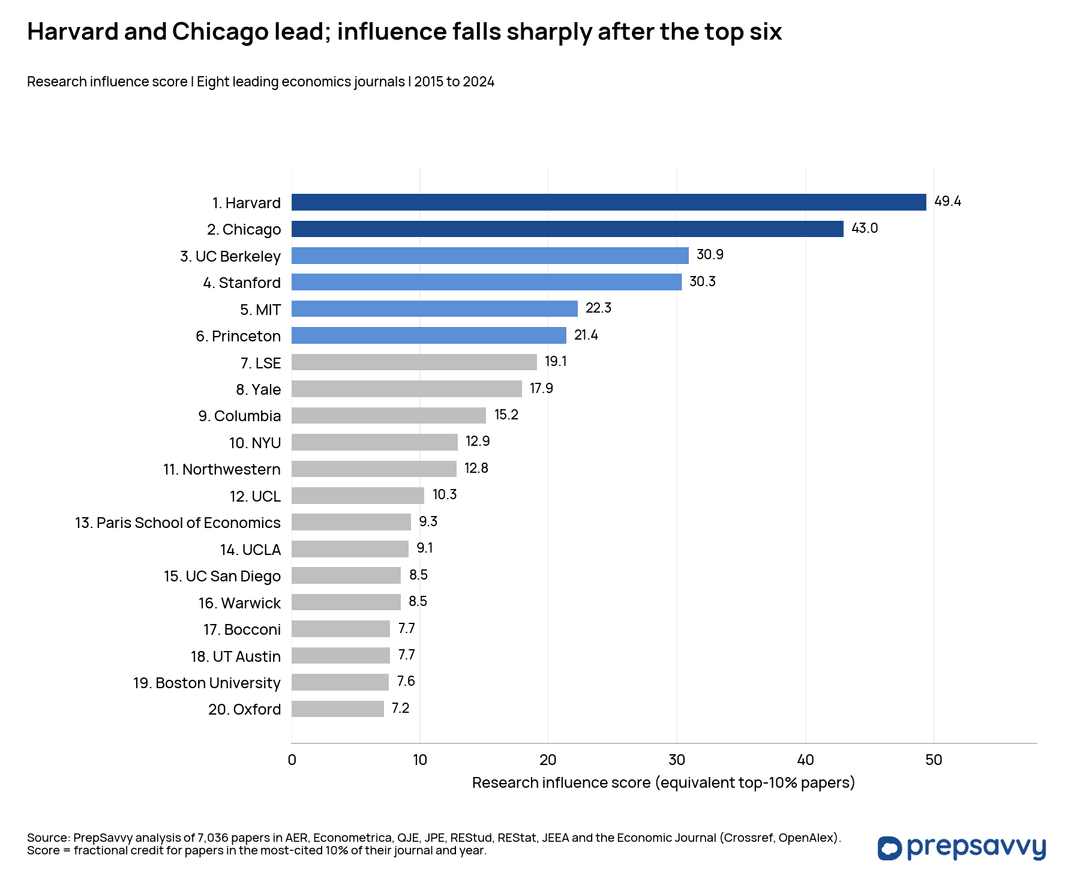
Harvard ranks first, the University of Chicago second and UC Berkeley third. Stanford, MIT and Princeton complete a top six made up entirely of American universities. The London School of Economics is the strongest economics school outside the United States, at seventh.
For anyone choosing an economics PhD or master's program, research influence matters because it tells you where the field's most important questions are being asked and answered. The researchers behind those papers are the people who teach graduate courses, supervise dissertations and write the recommendation letters that place graduates in academic and policy jobs.
How we ranked the schools
PrepSavvy analyzed 7,036 research papers published from 2015 to 2024 in eight leading general-interest economics journals: the American Economic Review, Econometrica, the Quarterly Journal of Economics, the Journal of Political Economy, the Review of Economic Studies, the Review of Economics and Statistics, the Journal of the European Economic Association and the Economic Journal. The first five are the field's "top five" journals, where publication shapes hiring and tenure decisions across the profession. The other three add leading outlets with a strong European presence.¹²
For each journal and publication year, we identified the papers in the most-cited 10%. A university's research influence score is its share of those papers. When several universities share a paper, they share its credit: a paper written by authors at Harvard and MIT counts as half a paper for each. Harvard's score of 49.4 therefore means that its contributions to the most-cited tenth of the field add up to about 49 papers' worth. Comparing papers only against others from the same journal and year keeps older papers, which have had more time to collect citations, from crowding out recent work.¹³
Why 56 universities qualified
A university needed at least 50 papers in these journals over the ten years to qualify, an average of five a year. Below that threshold, one heavily cited paper can move a school dozens of places, and the result reflects a single author rather than a department. Worldwide, 56 universities met the threshold.
Why we show the top 20
The top 20 is where the meaningful differences are. Below 20th place, scores fall under 7 and neighboring schools are often separated by a few hundredths of a point; 47th and 48th place are tied at 1.70. Rankings that fine describe noise, not a difference a student would experience.
The top 20 economics schools in the world
| Rank | University | Influence | Citations | Papers | Paper growth |
|---|---|---|---|---|---|
| 1 | 🇺🇸 Harvard University | 49.4 | 51,534 | 523 | -6% |
| 2 | 🇺🇸 University of Chicago | 43.0 | 38,714 | 526 | +14% |
| 3 | 🇺🇸 University of California, Berkeley | 30.9 | 31,450 | 362 | +14% |
| 4 | 🇺🇸 Stanford University | 30.3 | 34,248 | 426 | +2% |
| 5 | 🇺🇸 Massachusetts Institute of Technology | 22.3 | 32,605 | 378 | +2% |
| 6 | 🇺🇸 Princeton University | 21.4 | 23,660 | 280 | +12% |
| 7 | 🇬🇧 London School of Economics | 19.1 | 20,268 | 294 | -7% |
| 8 | 🇺🇸 Yale University | 17.9 | 18,156 | 269 | +47% |
| 9 | 🇺🇸 Columbia University | 15.2 | 20,098 | 277 | -1% |
| 10 | 🇺🇸 New York University | 12.9 | 15,641 | 232 | -2% |
| 11 | 🇺🇸 Northwestern University | 12.8 | 16,420 | 272 | +8% |
| 12 | 🇬🇧 University College London | 10.3 | 9,737 | 180 | +5% |
| 13 | 🇫🇷 Paris School of Economics | 9.3 | 5,324 | 104 | +26% |
| 14 | 🇺🇸 University of California, Los Angeles | 9.1 | 9,804 | 174 | +35% |
| 15 | 🇺🇸 University of California San Diego | 8.5 | 10,094 | 152 | +34% |
| 16 | 🇬🇧 University of Warwick | 8.5 | 5,706 | 147 | +37% |
| 17 | 🇮🇹 Bocconi University | 7.7 | 7,252 | 141 | +35% |
| 18 | 🇺🇸 University of Texas at Austin | 7.7 | 5,487 | 95 | +50% |
| 19 | 🇺🇸 Boston University | 7.6 | 10,552 | 129 | +30% |
| 20 | 🇬🇧 University of Oxford | 7.2 | 6,144 | 165 | +39% |
Citations are credit-shared in the same way as influence. Paper growth compares 2020 to 2024 with 2015 to 2019.
What the research shows
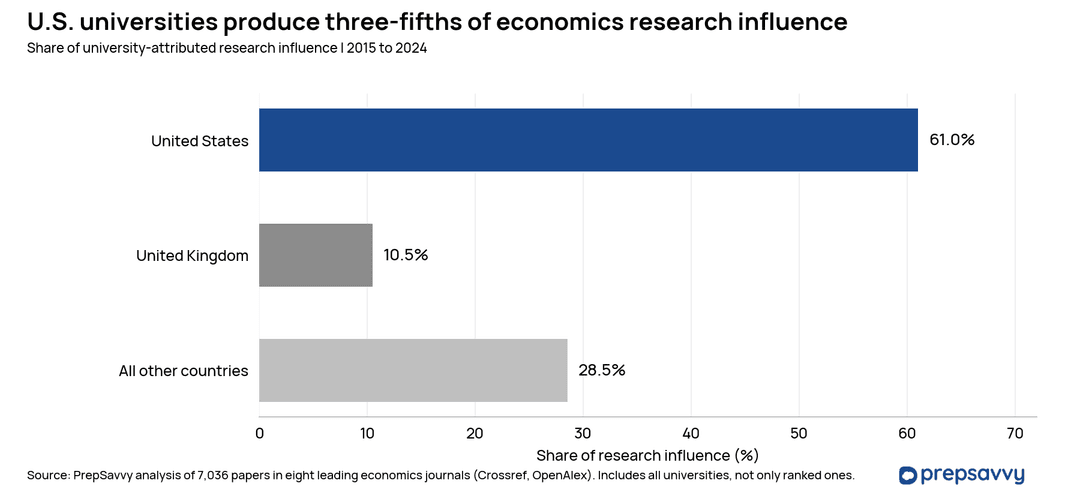
The United States remains the most influential country in economics research
American universities account for 61% of all research influence attributed to universities in these journals. The United Kingdom is a distant second at 10.5%. Fourteen of the top 20 schools are American, and so are all of the top six.¹
Several features of the American economy explain that lead. The United States has the largest consumer economy in the world, which gives economists the largest and most varied market to study. It is the leading example of free-market capitalism, so questions about prices, competition, labor markets and finance arise there first and at the largest scale. And compared with other major industrialized economies, the United States has relatively limited government intervention in markets, which leaves more economic activity to be recorded in prices, transactions and firm records. That environment has supported a sophisticated econometrics practice built on data that is captured reliably and at scale.
The most-cited papers in this study show what that data makes possible. Emmanuel Saez and Gabriel Zucman traced American wealth inequality back to 1913 using capitalized income tax records. Raj Chetty, Nathaniel Hendren and Lawrence Katz followed the children of the Moving to Opportunity housing experiment into adulthood. Daron Acemoglu and Pascual Restrepo measured the effect of industrial robots on American local labor markets. Each paper depends on detailed, long-running American records that few other countries collect or release at comparable scale.
Harvard and Chicago lead by a wide margin
Harvard scores 49.4 and Chicago 43.0. Together, the two account for 14% of all university-attributed research influence in the field. Chicago published the most papers of any university, 526 to Harvard's 523, but Harvard's papers reach the most-cited tenth more often.
The drop from Chicago to Berkeley is the largest in the top 20
Third-placed Berkeley scores 30.9, which puts Chicago 39% ahead of it. No other gap between adjacent schools in the top 20 is as large in absolute terms.
Berkeley and Stanford are neck and neck
Berkeley (30.9) and Stanford (30.3) are separated by 0.6 points, less than 2%. Stanford published 64 more papers and has more total citations; Berkeley places a higher share of its papers among the most cited.
MIT and Princeton form the next tier, and the scores then taper
Stanford's score is 36% higher than MIT's 22.3, the second large break in the table. MIT and Princeton (21.4) sit together, followed by LSE at 19.1 and Yale at 17.9. From there the scores decline gradually, and from 13th place to 20th the eight schools fall within 2.1 points of each other.
Yale is gaining ground fastest among the leaders
Paper counts in the eight journals grew 7.6% between the two five-year windows. Yale's grew 47%, from 109 to 160 papers, the largest gain in the top ten. After adjusting for each journal's growth, Yale's share of publication rose 39%, second only to the University of Michigan's 56% among universities with at least 100 papers. Warwick, UC San Diego, Bocconi and Oxford follow.¹
The top six economics schools in the world
The papers listed below are among each school's most-cited papers in the study, with the year the journal published them online. A school is credited when at least one author held an appointment there at publication; several authors have since moved.
1. Harvard University
Influence 49.4 | 523 papers | 51,534 citations
Harvard combines the largest concentration of economists working on inequality, mobility and labor markets with leading groups in macroeconomics, behavioral economics and political economy. Raj Chetty's Opportunity Insights team, Lawrence Katz and Claudia Goldin anchor the labor and inequality work. The department's younger faculty are especially decorated: Ludwig Straub won the 2026 John Bates Clark Medal and Stefanie Stantcheva the 2025 medal, Harvard's fourth winner in seven years.⁴
Influential papers
- "The Effects of Exposure to Better Neighborhoods on Children" (Chetty, Hendren and Katz), American Economic Review, 2016.
- "The Fall of the Labor Share and the Rise of Superstar Firms" (Autor, Dorn, Katz, Patterson and Van Reenen), Quarterly Journal of Economics, 2020.
- "The Growing Importance of Social Skills in the Labor Market" (David Deming), Quarterly Journal of Economics, 2017.
- "Global Evidence on Economic Preferences" (Falk, Becker, Dohmen, Enke, Huffman and Sunde), Quarterly Journal of Economics, 2018.
Nobel laureates: Claudia Goldin (2023), Oliver Hart (2016) and Eric Maskin (2007) are on the faculty. Harvard lists 12 economics laureates in its history.⁵
What to consider: Harvard's paper count fell 6% between the two windows, while its influence held. The PhD program requires the GRE, and applications are due December 1. Admitted students receive tuition, health insurance and stipend support.⁶
2. University of Chicago
Influence 43.0 | 526 papers | 38,714 citations
Chicago is the most productive economics school in the world by paper count, and its output grew 14% over the decade. Its identity is the Chicago School: the tradition of price theory, rigorous empirical testing and confidence in markets associated with Milton Friedman (Nobel 1976), George Stigler (1982), Ronald Coase (1991), Gary Becker (1992) and Robert Lucas (1995).⁷ That tradition now runs through the Becker Friedman Institute, which joins the economics department with the Booth School of Business, the Harris School of Public Policy and the Law School. John List, one of the field's leading experimental economists, has directed it since July 2025.⁸
Chicago's current work is broad. James Heckman studies human capital and early childhood. Michael Greenstone leads the Energy Policy Institute. Magne Mogstad, Ufuk Akcigit and Leonardo Bursztyn work on labor, innovation and political economy. Greg Kaplan's research reshaped monetary economics.
Influential papers
- "Democracy Does Cause Growth" (Acemoglu, Naidu, Restrepo and Robinson), Journal of Political Economy, 2019.
- "Monetary Policy According to HANK" (Kaplan, Moll and Violante), American Economic Review, 2018.
- "Railroads and American Economic Growth: A 'Market Access' Approach" (Donaldson and Hornbeck), Quarterly Journal of Economics, 2016.
- "Gender Identity and Relative Income within Households" (Bertrand, Kamenica and Pan), Quarterly Journal of Economics, 2015.
- "Human Decisions and Machine Predictions" (Kleinberg, Lakkaraju, Leskovec, Ludwig and Mullainathan), Quarterly Journal of Economics, 2017.
Nobel laureates: more than 35 economists affiliated with the university have won the prize. Eight are on the current faculty: James Robinson (2024), Douglas Diamond (2022), Michael Kremer (2019), Richard Thaler (2017), Eugene Fama and Lars Peter Hansen (2013), Roger Myerson (2007) and James Heckman (2000). Michael Woodford, one of the two 2026 laureates, is a Chicago graduate and former faculty member.⁹
A disclosure and a recommendation: I am a University of Chicago alumnus. That had no influence on this ranking, which comes entirely from journal data. We do personally recommend Chicago as a great school for economics.
What to consider: Chicago requires the GRE for its economics PhD and will not consider an application without official scores. Applications are due December 1, and the department enrolls 20 to 25 students a year from 600 to 700 applicants. Every PhD student is fully funded for the duration of the program.¹⁰
3. University of California, Berkeley
Influence 30.9 | 362 papers | 31,450 citations
Berkeley reaches third place with 362 papers, far fewer than Harvard or Chicago, because an unusually high share of its work lands among the most cited. Its strengths are public finance and inequality (Emmanuel Saez), labor economics (David Card, Patrick Kline, Enrico Moretti), macroeconomics (Emi Nakamura, Yuriy Gorodnichenko), development (Edward Miguel) and behavioral economics (Stefano DellaVigna, Ulrike Malmendier). It is also the leading public university in the ranking.
Influential papers
- "Revisiting Event-Study Designs: Robust and Efficient Estimation" (Borusyak, Jaravel and Spiess), Review of Economic Studies, 2024.
- "Wealth Inequality in the United States since 1913" (Saez and Zucman), Quarterly Journal of Economics, 2016.
- "Distributional National Accounts: Methods and Estimates for the United States" (Piketty, Saez and Zucman), Quarterly Journal of Economics, 2017.
- "Learning from Inflation Experiences" (Malmendier and Nagel), Quarterly Journal of Economics, 2015.
Nobel laureates: David Card (2021) remains at Berkeley as a professor emeritus and director of its Center for Labor Economics. The department counts six laureates: Gerard Debreu, John Harsanyi, Daniel McFadden, George Akerlof, Oliver Williamson and Card.¹¹
What to consider: Berkeley receives about 900 applications for 20 to 25 places. The Graduate Division lists the GRE as required, and the department advises applicants who score below 165 on the quantitative section to retake the test. Unlike the other five schools, Berkeley does not guarantee funding to every admit.¹²
4. Stanford University
Influence 30.3 | 426 papers | 34,248 citations
Stanford is the leading school for modern econometrics and the economics of technology. Its faculty produced several of the decade's most-used methods papers, the tools other economists rely on to measure cause and effect. Guido Imbens and Susan Athey lead that work, Nicholas Bloom studies productivity and management, and Matthew Gentzkow studies media and technology. Stanford's Graduate School of Business adds a second deep economics faculty.
Influential papers
- "Bartik Instruments: What, When, Why, and How" (Goldsmith-Pinkham, Sorkin and Swift), American Economic Review, 2020.
- "Synthetic Difference-in-Differences" (Arkhangelsky, Athey, Hirshberg, Imbens and Wager), American Economic Review, 2021.
- "When Should You Adjust Standard Errors for Clustering?" (Abadie, Athey, Imbens and Wooldridge), Quarterly Journal of Economics, 2022.
- "Trade Induced Technical Change? The Impact of Chinese Imports on Innovation, IT and Productivity" (Bloom, Draca and Van Reenen), Review of Economic Studies, 2015.
Nobel laureates: Robert Hall (2026, emeritus), Guido Imbens (2021), Paul Milgrom and Robert Wilson (2020) and Alvin Roth (2012).¹³
What to consider: Stanford requires the GRE, and applications are due December 2. It admits 20 to 25 students a year, and university policy funds every PhD student in good standing for five years.¹⁴
5. Massachusetts Institute of Technology
Influence 22.3 | 378 papers | 32,605 citations
MIT produced the most-cited paper in the entire study: "Robots and Jobs: Evidence from US Labor Markets" by Daron Acemoglu and Pascual Restrepo, with more than 4,000 citations. Its total citations exceed Berkeley's. Its influence score is lower because the score rewards how many papers reach the most-cited tenth, not the size of the biggest hits. MIT is strongest in labor and public economics (David Autor, Amy Finkelstein), development (Abhijit Banerjee, Esther Duflo), econometrics (Joshua Angrist) and political economy (Acemoglu).
Influential papers
- "Robots and Jobs: Evidence from US Labor Markets" (Acemoglu and Restrepo), Journal of Political Economy, 2020.
- "The Race between Man and Machine" (Acemoglu and Restrepo), American Economic Review, 2018.
- "Systemic Risk and Stability in Financial Networks" (Acemoglu, Ozdaglar and Tahbaz-Salehi), American Economic Review, 2015.
- "Railroads of the Raj" (Donaldson), American Economic Review, 2018.
Nobel laureates: Daron Acemoglu and Simon Johnson (2024), Joshua Angrist (2021), Abhijit Banerjee and Esther Duflo (2019). Bengt Holmström (2016) and Peter Diamond (2010) are emeritus. Seventeen MIT graduates have won the prize, including both 2026 laureates.¹⁵
What to consider: MIT requires the GRE and accepts applications until December 15. It receives about 800 applications and enrolls 20 to 24 students. Students hold fellowships in their first two years and are offered teaching or research assistantships after that.¹⁶
6. Princeton University
Influence 21.4 | 280 papers | 23,660 citations
Princeton is the smallest department in the top six by paper count and grew its output 12% over the decade. It is strongest in macroeconomics and finance (Markus Brunnermeier, Giovanni Violante, Atif Mian), international trade (Gene Grossman) and econometrics (Mark Watson, Ulrich Müller).
Influential papers
- "CoVaR" (Adrian and Brunnermeier), American Economic Review, 2016.
- "Monetary Policy According to HANK" (Kaplan, Moll and Violante), American Economic Review, 2018.
- "The Short-term Impact of Unconditional Cash Transfers to the Poor" (Haushofer and Shapiro), Quarterly Journal of Economics, 2016.
- "Household Debt and Business Cycles Worldwide" (Mian, Sufi and Verner), Quarterly Journal of Economics, 2017.
Nobel laureates: Angus Deaton (2015), Christopher Sims (2011) and Paul Krugman (2008) won the prize as Princeton faculty. Deaton and Krugman are now emeritus.¹⁷
What to consider: Two of the researchers behind Princeton's most-cited papers in this period, Benjamin Moll and Stephen Redding, have since left for LSE and Stanford. Princeton enrolls 20 to 25 PhD students a year, with applications due December 1. Check the Graduate School's current testing policy before applying.¹⁷
How to use this ranking
Research influence identifies where the field's most important work happens. It does not measure teaching quality, class size or job placement, and it reflects a department's faculty over the last decade. Use the ranking to build a shortlist, then read the recent papers of the faculty you would want to work with: their questions and methods tell you more about your fit than a rank does.
Five of the six leading programs require the GRE, and admitted students typically score near the top of the quantitative section. PrepSavvy's GRE preparation is built for applicants aiming at that level. For the same method applied to another field, see our ranking of the top philosophy schools.
Data and code
The full dataset behind this ranking is public on GitHub: all 7,036 papers with their citations and university affiliations, the eight journals, the 56-university index, the 27 excluded items, and a Python script that reproduces every rank and score. It is free to reuse under CC BY 4.0 with attribution to PrepSavvy.
Explore the full economics research dataset to compare all 56 universities, filter the results and download the evidence.
Practice for free
PrepSavvy has free GRE, GMAT and ACT practice questions, and every answer comes with a full explanation.
Start practicing freeFrequently asked questions
What are the top 5 universities in economics?
By research influence in the leading economics journals from 2015 to 2024, the top five are Harvard, the University of Chicago, UC Berkeley, Stanford and MIT. Princeton is sixth.
Which university has the best economics program?
Harvard has the highest research influence score, 49.4. The University of Chicago is second at 43.0 and published the most papers of any university, 526.
What are the top 10 universities for economics in the world?
Harvard, Chicago, UC Berkeley, Stanford, MIT, Princeton, the London School of Economics, Yale, Columbia and NYU, in that order.
What are the best economics PhD programs?
The six most influential programs are Harvard, Chicago, Berkeley, Stanford, MIT and Princeton. Each enrolls roughly 20 to 30 PhD students a year, and Harvard, Chicago, Stanford and MIT require the GRE.
Do economics PhD programs require the GRE?
Most leading programs do. Harvard, Chicago, Stanford and MIT require it, and Berkeley's Graduate Division lists it as required. Chicago does not consider applications without official scores, and Berkeley advises applicants below 165 on the quantitative section to retake the test.
What are the top economics journals?
The field's top five are the American Economic Review, Econometrica, the Quarterly Journal of Economics, the Journal of Political Economy and the Review of Economic Studies. This ranking also includes the Review of Economics and Statistics, the Journal of the European Economic Association and the Economic Journal.
How is this ranking different from QS, US News and RePEc?
QS combines reputation surveys with citation measures, and US News ranks graduate economics programs by peer assessment surveys. RePEc ranks institutions on publications and citations across a much larger set of journals. This ranking measures only each university's share of the most-cited 10% of papers in eight leading journals, with credit shared between co-authoring universities.
Which country is best for studying economics?
The United States, by a wide margin. American universities produce 61% of the research influence attributed to universities in these journals, and the United Kingdom is second at 10.5%.
What are the best economics schools in Europe?
The London School of Economics ranks seventh in the world. University College London (12th), the Paris School of Economics (13th), Warwick (16th), Bocconi (17th) and Oxford (20th) also rank in the top 20.
Sources
- PrepSavvy economics research index, edition 2026-10-27: 7,036 papers in eight economics journals, 2015 to 2024, with data and calculation code, PrepSavvy (accessed 2026-10-27)
- Publisher journal metadata: AER, Econometrica, QJE, JPE, Review of Economic Studies, Review of Economics and Statistics, JEEA and Economic Journal, Crossref (accessed 2026-10-26)
- Journal-work citation counts and institutional affiliations, OpenAlex (accessed 2026-10-26)
- Ludwig Straub, 2026 Clark Medal recipient, Harvard Department of Economics (accessed 2026-11-18)
- Nobel laureates in economic sciences, Harvard University (accessed 2026-11-18)
- Economics PhD program: requirements and deadlines, Harvard Kenneth C. Griffin Graduate School of Arts and Sciences (accessed 2026-11-18)
- Department history, University of Chicago Kenneth C. Griffin Department of Economics (accessed 2026-11-18)
- John List appointed director of the Becker Friedman Institute for Economics, UChicago News (accessed 2026-11-18)
- Michael Woodford, UChicago alum and former faculty member, shares Nobel Prize, UChicago News (accessed 2026-11-18)
- GRE General Test requirements, University of Chicago Division of the Social Sciences (accessed 2026-11-18)
- Awards, UC Berkeley Department of Economics (accessed 2026-11-18)
- Graduate admissions instructions, UC Berkeley Department of Economics (accessed 2026-11-18)
- Nobel Prize, Stanford School of Humanities and Sciences (accessed 2026-11-18)
- Applying to Stanford, Stanford Department of Economics (accessed 2026-11-18)
- Robert Hall and Michael Woodford share Nobel Prize in economics, MIT News (accessed 2026-11-18)
- PhD program admissions, MIT Department of Economics (accessed 2026-11-18)
- Graduate program, Princeton Department of Economics (accessed 2026-11-18)
More in University Rankings by Research.
Top Philosophy Schools Worldwide for Research and Influence
Compare worldwide philosophy research influence, citation concentration and publication growth.
· 5 min read