

Four GMAT study tips that took me from 690 to 760
Four tips that you can use to work efficiently, study smarter and score higher, based on my own experiences doing the real thing.

On this page
I dreamed for a long time of attending a top business school in the U.S. However, one obstacle stood in the way of me and my MBA: the GMAT.
Just thinking about the exam filled me with dread. I'd been out of school for years at this point, and the last thing I wanted to do was study for more tests. But there was no way around it. I had to get to work.
The first time I did the GMAT, I scored a 690. It was a good score, in about the 85th percentile. However, my aim was to go to an M7 business school, and I knew that any score that started with a "6" and not a "7" was not going to be competitive.
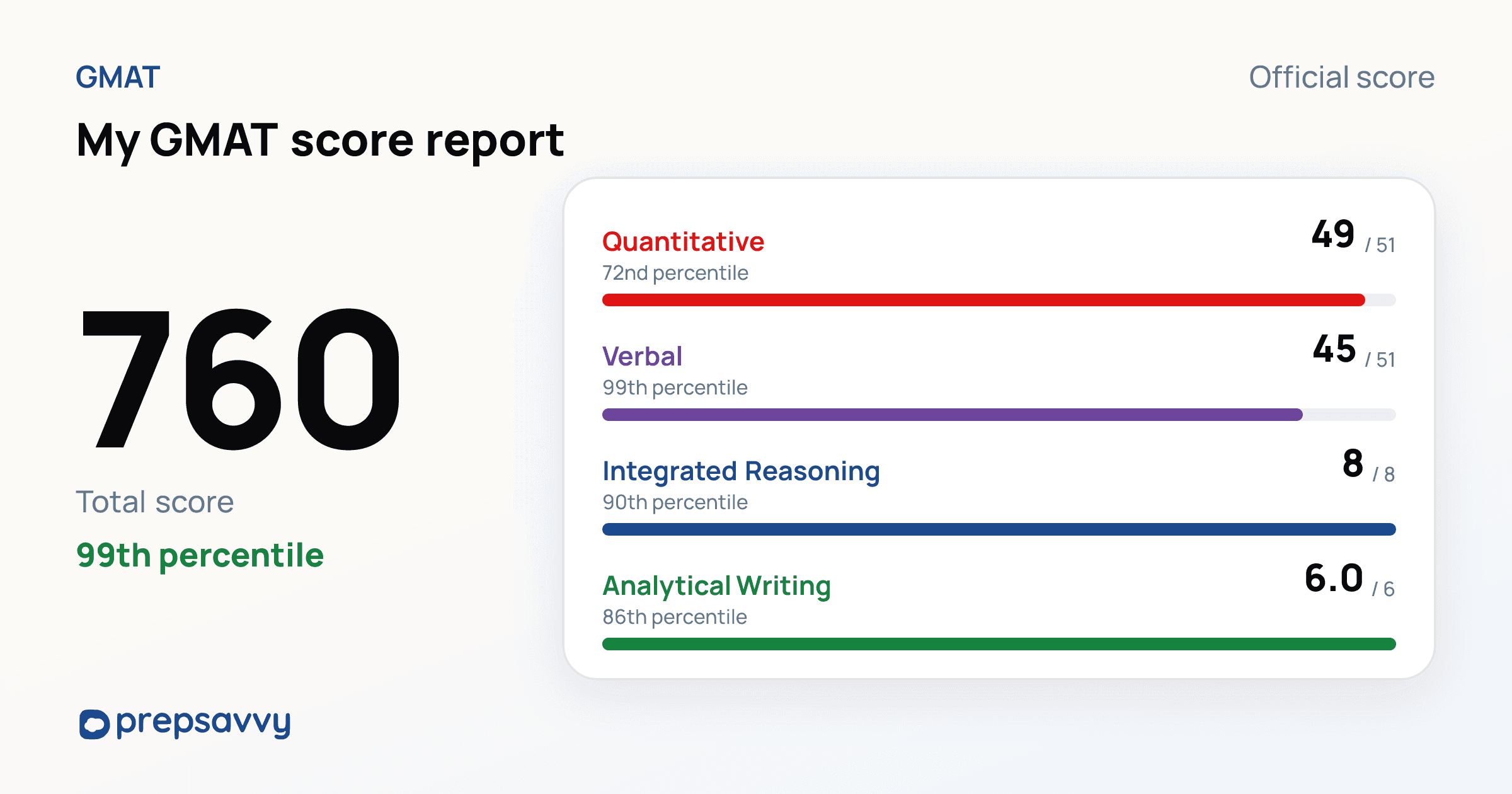
So I took it again. I had three months. The second time, I scored a 760, landing in the 99th percentile.
Here is the exact method I used, and the one I would encourage anybody to use for any standardized exam. And please note: while we do use AI extensively in building many aspects of PrepSavvy, this post is written directly by me, the founder, with no assistance from AI. This one is from the heart.
1. Take a full-length test with no time limit
Pro tip: Put the timer away. Start by doing a full-length practice exam with no time constraints, no pressure, and no goal other than finishing as accurately and thoroughly as possible.
A standardized exam is much like a triathlon. A triathlon has a swimming, cycling, and running component, just as the GMAT Focus Edition and the GRE each have three sections.
If you want to compete in a triathlon, the best way to get started is to do a triathlon. It might take you all day, and that's okay. You'll learn what the full experience is like. You'll get a sense of what is easier and what is harder, and at what points you start to feel fatigued either physically or mentally. It doesn't matter if you sprint, jog, walk or crawl: it matters that you finish. This is your starting point.
You might find that swimming comes easily to you, while cycling and running are hard. Or you might find that cycling is physically easy but mentally . This is valuable. You will gain great insights about yourself by sitting through the experience and knowing exactly what you are up against.
By the same logic, the best way to study for an exam is to do the exam. It sounds trite, but it's easy to overlook in a world saturated by expensive tutoring packages, crash courses and study guides. But you can't get away from the basics. If you want to ace the GMAT, do the GMAT.
My best advice for anybody studying for any exam is to set aside a few hours, crack open a practice exam, and do it end to end. And very importantly: put the timer away. You aren't trying to break records at this point. You are trying to get a sense of the experience.
Why remove the timer? Because you aren't ready for game day yet, and that's okay. Instead of focusing on completing the exam quickly, you can focus on understanding exactly what is being asked, what each question is testing, and what comes easily and what seems hard. This is crucial to establishing a strong benchmark and finding out exactly where you stand on Day 1.
2. Review the entire exam
Pro tip: Review the answer key for all the questions in the exam: not just those that you got wrong, but also those that you got right.
A common study tactic is to do an exam end to end, find out what questions you got right and wrong, and then study those that you got wrong.
But I say no. Don't just read what you got wrong. Read what you got right.
Why? Because by the time you've completed a multi-hour exam, you'll have forgotten which questions you struggled with and which answers you guessed under fatigue. You may have spent ten minutes on a single question about all the different ways to stack books of different colors on a bookshelf, only to later learn that a simple formula could have gotten you the correct answer reliably in a fraction of the time.
Of course, your study should be centered on your weaknesses. That comes next. Before that, review what you got wrong and what you got right. Celebrate your wins, look for faster ways to get the right answers, and then determine what you need to study most.
Be patient with this process. Discovering shortcuts and tricks will help you tackle more complex variants of the same questions. You miss them if you jump straight to what you got wrong.
3. Focus on your weaknesses
Pro tip: The Pareto principle applies with studying: 80% of your improvement will come from 20% of your study efforts.
At this point, the study journey is straightforward. You know your strengths and weaknesses. Now it's time to focus on your weaknesses.
Let's revisit the triathlon analogy, with swimming, cycling, and running. It turns out you're great at the cycling, but the swimming and the running need more work. So you run every morning and swim every evening. Get into the habit of focusing your attention where you need it, build a study routine, and stick to it.
When I was studying for the GMAT, I quickly learned that my verbal foundations were strong. I only needed to focus my efforts on the quantitative section, and even more narrowly on combinatorics, integer properties, and algebra. Your mileage may vary, but as you go through any standardized exam, you'll find things that come naturally to you and things that require a bit more practice. Modern test prep platforms like PrepSavvy take the guesswork out of this, and help you identify exactly what areas you should focus on.
4. Get ready for game day
Pro tip: Now is the time to pull out the timer. Treat every practice exam like game day, and show up ready to win.
Let's recap. You started with a full-length exam. You found what you needed to improve. You've been doing the reps on the areas that need the most work. Now it's time to see how you perform on game day.
As I said earlier, the best way to study for the GMAT is to do the GMAT. Brushing up on your weaknesses matters, but you also need to perform across a multi-hour exam, uninterrupted and undeterred by fatigue. You don't want your first timed exam to be the one at the test center.
You will need to set aside several hours for this. If you're working or studying full-time, you might need to dedicate time over weekends or other periods where you can afford to have several consecutive hours to study.
Putting it all together
Beyond these four tips, the study journey boils down to: rinse and repeat. With each practice exam, your score should improve. If it doesn't, read every single explanation in your exam, including what you got right and what you got wrong, and try again. Don't be discouraged if you lose progress along the way. Keep at it.
It will be a sacrifice, and it won't always be fun. But getting into your dream school is not easy, and you'll be competing with the best and the brightest from around the world.
It pays off. When I walked into the Pearson VUE test center for my second GMAT, it honestly felt easy. Why? Because I'd done it many times before. I knew the pacing, I knew what section order worked for me, I knew that fatigue would hit midway through the Verbal section, and I knew that I could push through it. I walked out with a 760.
How PrepSavvy helps
PrepSavvy is built by a CEO who eats his own dog food. Every practice described here is a faithful replication of exactly how I studied, and I believe it can help you achieve the score of your dreams.
We've built PrepSavvy exactly with these study tips in mind. PrepSavvy allows you to take exams without a timer, to review explanations for all questions and answers, to learn shortcuts and tricks to pace yourself efficiently, and to receive advanced analytics to help you focus on your weaknesses. And we're shipping features that I wish I had, like Preppy, our AI tutor, who lets you ask about difficult problems at your own pace.
All of this is designed to help you study smarter and score higher.
Start where you are
My focus was on the classic GMAT, but if you're studying for the GMAT Focus Edition, the GRE, or any other standardized exam, these principles will apply equally to you.
Wherever you are, start with a free practice test and see where your points are going. For how I fit three months of study around a full-time job, read how I got a 760 on the GMAT while working full time. For a week-by-week structure, the GMAT study plan lays out the full 12 weeks, and why I built PrepSavvy tells the rest of the story.
If you have questions or feedback, write to me at mark@prepsavvy.ai. I read every message.
Take a free GMAT practice test
Sit a timed, adaptive GMAT practice test and get a score report that shows where you lose points.
Start the free practice test
How I got a 760 on the GMAT while working full time
Building a study habit you can keep and showing up every day are key to reaching the score of your dreams.
· 3 min read

Why I built PrepSavvy
The MBA transformed my life. The GMAT almost got in the way.
· 4 min read