

How I got a 760 on the GMAT while working full time
Building a study habit you can keep and showing up every day are key to reaching the score of your dreams.


Let's face it: there is more to life than just studying. By the time we are looking to get into college or graduate programs, we are usually balancing work, social, family, and other obligations.
With that said, studying for an exam like the GRE, the GMAT Focus Edition, or other professional exams takes time. There is no way around it. If you want to run faster, you need to run laps every morning. If you want to score higher, you need to put in the time.
Whether you're just starting or midway through your study journey, it helps to get into a good study routine. Here are my tips to do exactly that.
Get into a study routine
We've all crammed for finals. It won't work for professional exams.
Why? Because these exams test a broad range of subjects with complex logical patterns. Acing these exams isn't about memorizing materials. It's about recognizing patterns, applying winning strategies, and working efficiently. You can't improvise.
Plan to dedicate at least a few months to prepare. Figure out a pace you can commit to while retaining your sanity. If that's daily after work, twice a week in early mornings, during your morning commute, or once a week on Saturdays, great. Whatever works. But set yourself a schedule and stick to it.
I reached the 99th percentile on the GMAT, and a consistent study routine was critical to my success.
I was working full time, and after a full day of meetings, my brain was fried. The last thing I wanted to do was to crack open a textbook. But I knew I needed to put in the time to get the score I wanted. So I did something radical.
Prior to my study journey, I'd go to sleep around midnight, and wake up around 7:30am. To build a daily habit, I shifted my clock three hours earlier: I'd set my alarm for 4:30am and sleep around 9pm. I'd study in the morning before work, while my energy was high and my mind was fresh. I didn't always look forward to it, but I also walked into the office every morning knowing the hardest part of my day was already over.
My study routine included an hour every weekday, at my desk with my morning coffee. I'd also block out every other Saturday for lengthier sessions, where I could do full-length practice exams. Most weeks, this came to five hours: nothing crazy, but enough to get me the score I wanted in three months.
Show up
Repetition is the key to learning. It is true for languages, it is true for sports, and it is true for exams.
Setting a schedule is the first step. Sticking to it is the hard part.
It's hard to overstate the importance of this. Consistency beats intensity every time. Whether you practice 10 minutes a day on your phone while commuting to work, or 10 hours a week, you need to show up.
Nobody ever became fit after a single session at the gym. Acing these exams is the result of showing up again, and again, and again. You cannot cram your way into success. Building a daily habit of answering questions is how you develop your exam muscles.
Study smarter, score higher
You do not need to quit your job or study ten hours a day. Pick a pace you can keep, set your schedule, and show up again tomorrow. When you're ready, here is the method I used: four GMAT study tips that took me from 690 to 760.
You got this.
Start where you are
If you are studying for the GRE, the GMAT or the ACT, start with a free practice test and see where your points are going. For a week-by-week structure, the GMAT study plan lays out the full 12 weeks.
If you have questions or feedback, write to me at mark@prepsavvy.ai. I read every message.
Take a free GMAT practice test
Sit a timed, adaptive GMAT practice test and get a score report that shows where you lose points.
Start the free practice test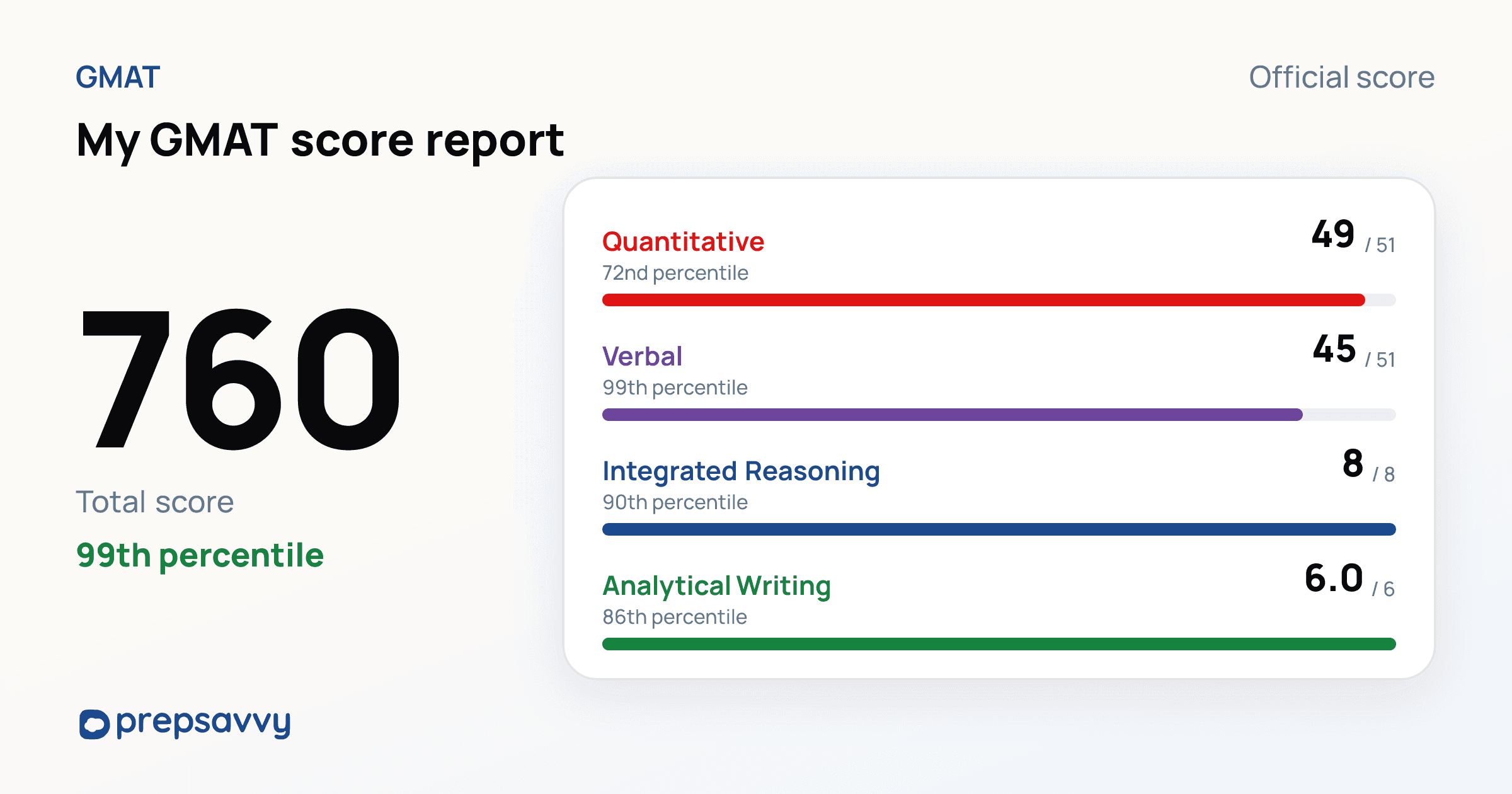
Four GMAT study tips that took me from 690 to 760
Four tips that you can use to work efficiently, study smarter and score higher, based on my own experiences doing the real thing.
· 7 min read